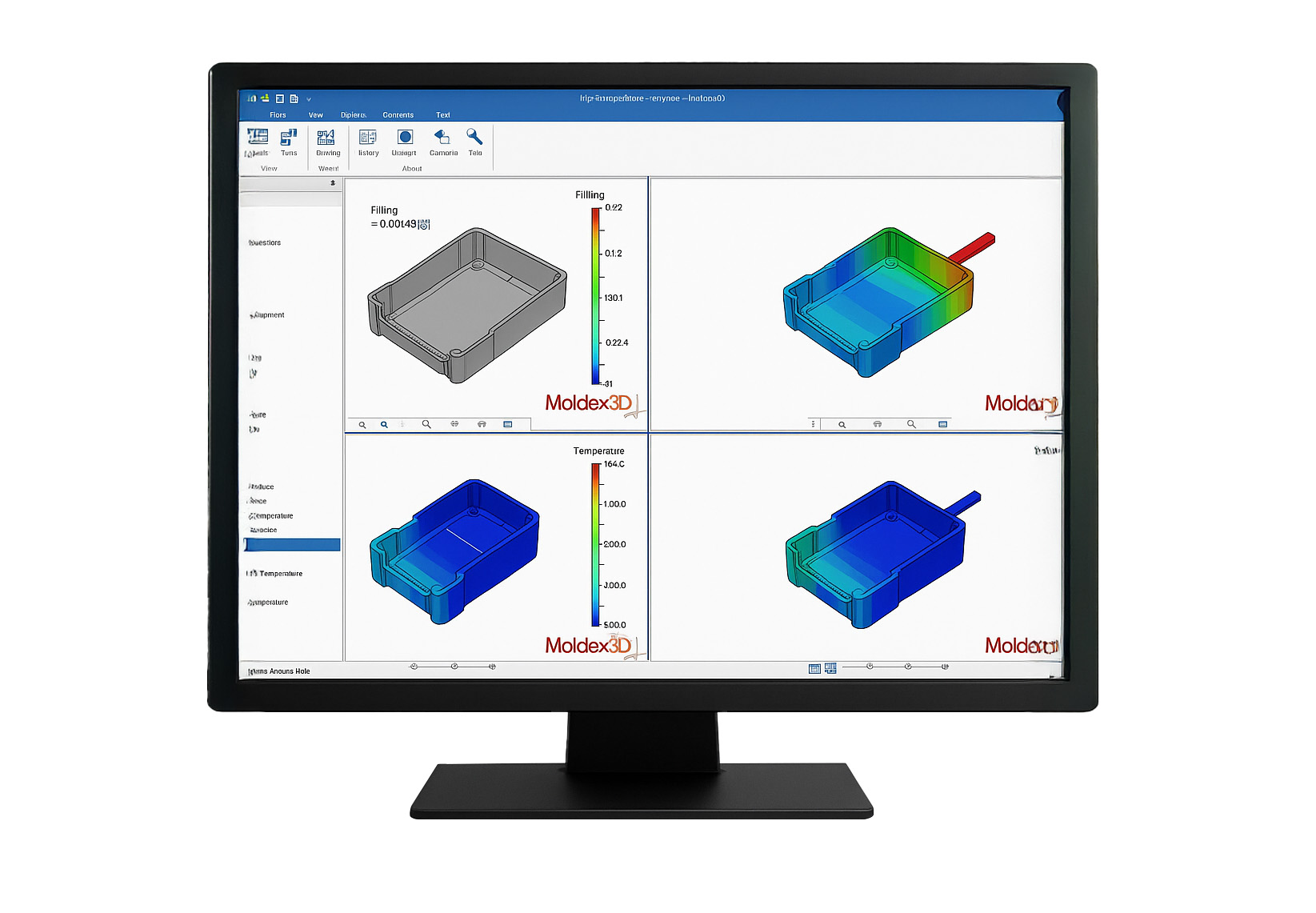
Assisting clients in enhancing product reliability and stabilizing mass production quality.
Moldflow analysis is a vital tool in the development phase of plastic injection molding. By simulating melt flow, packing behavior, and cooling conditions, it allows us to predict potential defects before we create plastic molds and optimize injection mold design. This ensures consistent quality, shortens development cycles, and reduces trial runs, making it an indispensable step in the fabrication of custom plastic parts.
1
Mold Flow Analysis
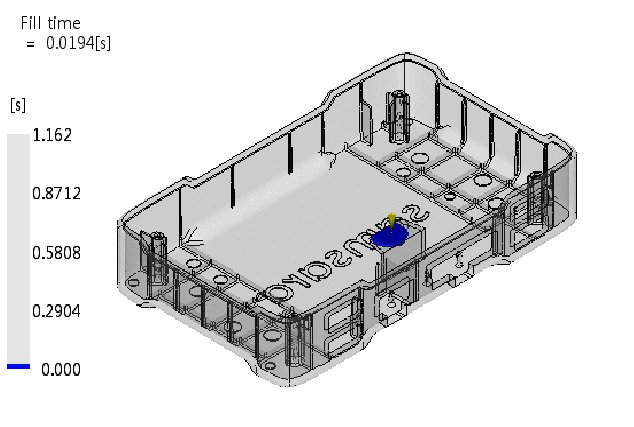
Predicts the melt flow path within the plastic mold to identify potential issues such as:
■ Air traps ■ Short shots ■ Weld lines ■ Uneven filling
It also assists in optimizing gate locations, runners, and wall thickness to improve product moldability.
2
Holding Pressure Analysis
Analyzes pressure distribution during the packing phase to ensure the dimensional stability of injection molded parts, and minimizes:
■ Shrinkage
■ Sink marks
■ Warpage
■ Dimensional deviation
Helping clients improve mass production yield.
3
Warp Analysis
Predicts deformation trends after cooling to understand the causes of warpage (uneven wall thickness, fiber orientation, uneven cooling), and provides improvement recommendations to ensure the appearance and dimensional stability of custom plastic parts.
4
Cooling Analysis
Verifies the effectiveness of cooling channels in the injection mold design and evaluates cooling system efficiency:
■ Is cooling uniform?
■ Can cycle times be reduced?
■ Will it cause warpage or sink marks?
Assisting clients in reducing cycle times and improving production efficiency.
5
Defect Prediction
Moldflow analysis provides early prediction of:
■ Weld lines
■ Air traps
■ Jetting
■ Short shots
■ Deformation caused by fiber orientation
This allows clients to adjust plastic part design for injection molding or process parameters before injection mold building, significantly reducing risks.
Advanced Moldflow Analysis Process
T0
Pre-mold Analysis
Utilizes CAD models to conduct preliminary Moldflow analysis and evaluate:
■ Moldability
■ Melt filling paths
■ Structural risks of the plastic design
■ Gate and runner layout for injection mold design
At this stage, the parameters derived from the preliminary simulation are used to conduct prototype injection molding on the machine.
T1
Generating Real Data
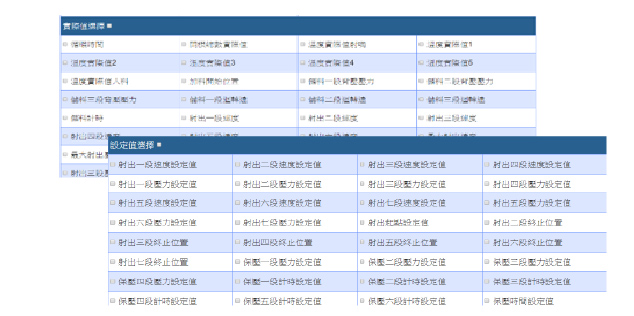
Our equipment outputs real injection molding parameters, including injection pressure, speed, melt temperature, mold temperature, packing time, and cooling time.
These data can be directly imported into the Moldflow model, aligning simulation results with actual mass production conditions and significantly enhancing analysis accuracy.
Benefits:
■ Simulation is no longer just theoretical.
■ Results closely reflect actual custom injection molding.
■ Reduces machine tuning time.
■ Facilitates rapid confirmation of optimal molding parameters.
T2-Tf
Precision Optimization
When the injection mold design is adjusted or process conditions change, we re-apply mass production data to the new Moldflow model. This enhances simulation accuracy, enabling rapid comparison of differences and optimization of cooling, packing, warpage, and dimensional precision. Ultimately, this ensures greater stability during the plastic injection molding phase and reduces adjustment time.
We offer professional Moldflow / Moldex3D analysis reports to help customers eliminate common defects in the plastic injection molding process.
We use cookies to improve your user experience and for web traffic statistics purposes. By continuing to use this website, you agree to our use of cookies. Our Privacy & Cookie Policy. contains more information on such use and explains how to disable cookies. ACCEPT
Manage consent
Privacy Overview
This website uses cookies to improve your experience while you navigate through the website. Out of these, the cookies that are categorized as necessary are stored on your browser as they are essential for the working of basic functionalities of the website. We also use third-party cookies that help us analyze and understand how you use this website. These cookies will be stored in your browser only with your consent. You also have the option to opt-out of these cookies. But opting out of some of these cookies may affect your browsing experience.
Necessary cookies are absolutely essential for the website to function properly. This category only includes cookies that ensures basic functionalities and security features of the website. These cookies do not store any personal information.
Any cookies that may not be particularly necessary for the website to function and is used specifically to collect user personal data via analytics, ads, other embedded contents are termed as non-necessary cookies. It is mandatory to procure user consent prior to running these cookies on your website.